Breathwork Pranayama for Beginners
Breathwork 101: Pranayama Techniques for Beginners
We take about 20,000 breaths a day and for most of us, every single one happens on autopilot. We rarely think about how we breathe.
But in the yogic tradition, breath is far more than a biological reflex. It's called Prana - Life Force and the practice of consciously directing and regulating it is called pranayama.
This guide will walk you through what pranayama is, why it works, and five beginner-friendly techniques you can start practicing today.
What is Pranayama?
The word pranayama comes from two Sanskrit roots: prana (life force or vital energy) and ayama (to extend, draw out, or control). Put simply, pranayama is the practice of consciously regulating the breath to influence the flow of energy in the body and mind.
In the classical yogic framework - the eight limbs of yoga outlined by Patanjali - pranayama is the fourth limb, positioned as a bridge between the physical practice of asana (postures) and the more internal, meditative limbs that follow. The idea is elegant: a steady body leads to a steady breath, and a steady breath leads to a steady mind.
Modern science backs up what yogis have intuited for thousands of years - the breath is one of the few bodily functions that is both automatic and voluntary, which makes it a uniquely powerful lever for shifting our physical and emotional state on demand.
Why Breathwork Works: The Science in Plain Language
Your breath is directly wired into your autonomic nervous system - the part of your nervous system that controls things you don't consciously manage, like heart rate, digestion, and stress hormones. This system has two main modes:
- Sympathetic ("fight or flight") activated by stress, danger, or urgency. Breathing becomes fast and shallow, heart rate rises, muscles tense.
- Parasympathetic ("rest and digest") activated by safety and calm. Breathing slows and deepens, heart rate lowers, the body relaxes.
Here's the powerful part: because breathing is one of the only autonomic functions, we can consciously control, we can use it as a direct switch between these two states. Slow, deep breathing - especially with a longer exhale than inhale - signals safety to the nervous system, activating the parasympathetic response even when the mind is still racing.
This is why a few rounds of slow breathing can lower heart rate, ease anxiety, improve focus, and even support better digestion and sleep. You're not just "calming down" in an abstract sense - you're triggering a measurable physiological shift.
Before You Begin: A Few Ground Rules
- Practice on an empty stomach. Wait at least 2–3 hours after a meal.
- Sit comfortably. A cross-legged seated position works well, but a chair is fine too - the priority is a tall, relaxed spine.
- Start small. 3–5 minutes a day is plenty when you're new. Consistency matters more than duration.
- Never force or strain. If you feel dizzy, lightheaded, or uncomfortable, return to normal breathing immediately.
- Skip breath retention (holding the breath) if you're pregnant or have high/low blood pressure, heart conditions, or respiratory issues - unless guided by a qualified teacher or doctor.
Five Pranayama Techniques for Beginners
1. Diaphragmatic Breathing (Belly Breathing)
The foundation of all pranayama - start here before anything else.
Most adults breathe shallowly into the chest, especially under stress. Belly breathing retrains you to use the diaphragm fully, which is calmer, more efficient, and the base skill every other technique builds on.
How to practice:
- Sit or lie down comfortably. Place one hand on your chest, one on your belly.
- Inhale slowly through the nose, letting your belly rise while your chest stays relatively still.
- Exhale slowly, feeling the belly fall.
- Continue for 5–10 rounds, keeping the breath smooth and unforced.
Best for: General stress relief, anytime, anywhere - including before a stressful meeting or during a flight.
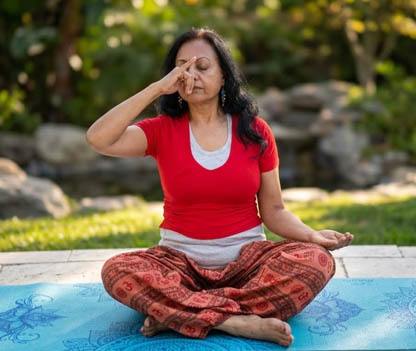
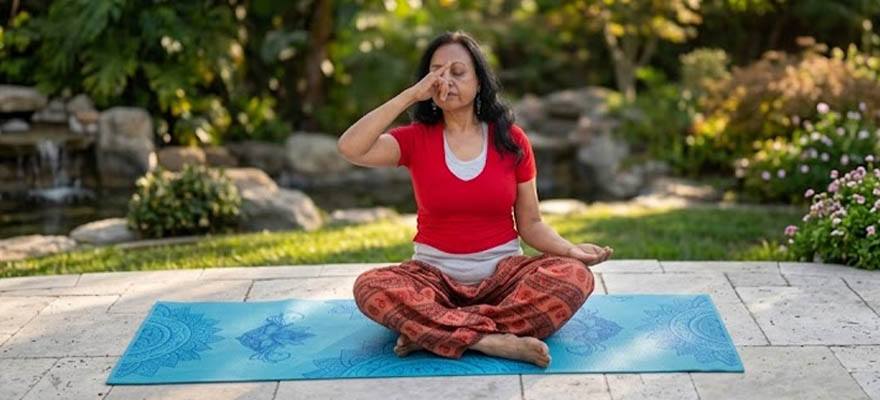
2. Nadi Shodhana (Anuloma Viloma), (Alternate Nostril Breathing)
A classic for balancing and calming the mind.
Nadi Shodhana means "channel purification." Alternating airflow between nostrils is believed to balance the two hemispheres of the brain and harmonize the nervous system - and many practitioners report a genuine sense of mental clarity afterward.
How to practice:
- Sit comfortably. Bring your right thumb to your right nostril and right ring finger to your left nostril.
- Close the right nostril, inhale slowly through the left.
- Close the left nostril, release the right, and exhale through the right.
- Inhale through the right, close it, release the left, and exhale through the left.
- This completes one round. Continue for 5–10 rounds.
Best for: Mental clarity, focus before work or study, balancing an overactive or scattered mind.
3. Ujjayi Breath ("Ocean Breath" or "Victorious Breath")
Ujjayi involves a slight constriction at the back of the throat, creating a soft, ocean-like sound with each breath. It's commonly used throughout vinyasa and ashtanga practices to help maintain focus and rhythm.
How to practice:
- Inhale and exhale through the nose only.
- Gently stretch the lips and bring beautiful smile on the face.
- Slightly constrict the back of your throat with full awareness.
- Inhale to create a soft "ocean wave" sound.
- Exhale longer with little louder and soft "ocean wave" sound.
- Keep the breath long, smooth, and audible, but not forced or strained.
Best for: Building focus and steady rhythm during movement or meditation.
4. Bhramari ("Humming Bee Breath")
One of the fastest ways to calm anxiety.
Bhramari involves making a gentle humming sound on the exhale, named for its resemblance to the buzz of a bee. The vibration is remarkably soothing and is often used for quick anxiety relief.
How to practice:
- Sit comfortably, close your eyes, and take a few natural breaths.
- Gently place your index fingers on the cartilage of each ear (optional but enhances the effect).
- Inhale through the nose, then exhale slowly while making a low, steady humming sound.
- Feel the vibration in your head and face. Repeat for 5–7 rounds.
Best for: Quick anxiety relief, calming racing thoughts, easing tension headaches.
5. Sama Vritti ("Box Breathing / Equal Breathing")
Simple, structured, and easy to remember under stress.
Sama Vritti means "equal breath" the inhale, hold, exhale, and (optionally) hold again are all equal in length. This structured rhythm is popular even outside yoga circles - it's widely used by athletes, first responders, and even military personnel to stay calm under pressure.
How to practice:
- Inhale through the nose for a count of 4.
- Hold gently for a count of 4.
- Exhale through the nose for a count of 4.
- Hold gently for a count of 4 (skip this if it feels uncomfortable at first).
- Repeat for 4–8 rounds.
Best for: Grounding before a stressful event, improving focus, building overall breath control.
Building Simple Daily Practice
You don't need to do all five techniques every day. A simple, sustainable approach for beginners:
- Morning (2–3 minutes): Diaphragmatic breathing or Nadi Shodhana, to start the day centered.
- Midday reset (1–2 minutes): Box breathing before a stressful task or meeting.
- Evening (3–5 minutes): Bhramari or slow diaphragmatic breathing, to unwind before sleep.
Even five focused minutes a day is enough to begin noticing a difference - in your stress levels, your sleep, and your ability to stay present.
A Gentle Reminder
Pranayama is powerful precisely because it's simple - no equipment, no special setting, no advanced flexibility required. The only real requirement is attention. As you practice, you may notice moments of resistance, restlessness, or even emotion surfacing - this is normal. The breath has a way of loosening things the mind has been holding onto.
Be patient with yourself. Like any practice, the benefits of pranayama build gradually, breath by breath, day by day.
As always, if you have any respiratory, cardiovascular, or blood pressure conditions, or are pregnant, check with your doctor before starting breath-retention practices, and consider learning from a qualified teacher in person.