Knee and Joint Health Yoga
Yoga for Knee and Joint Health
The knee is one of the hardest-working joints in the body - bearing your full body weight with every step, absorbing impact, and allowing you to walk, climb stairs, sit, and stand. It's also one of the most structurally vulnerable joints, relying heavily on the strength and flexibility of the muscles around it (quadriceps, hamstrings, calves, hips) for stability, since the knee itself has relatively little inherent support from bone structure alone.
Whether you're dealing with mild stiffness, age-related wear, past injury, or a diagnosed condition like osteoarthritis, yoga can be a genuinely supportive practice. This guide covers few joint-friendly yoga practices and safe poses for knee and joint health, and key adjustments to avoid aggravating existing issues.
A Few Important Notes Before You Begin
Before diving into poses, some honest ground rules:
- This is general guidance, not a diagnosis or treatment plan. Knee pain can stem from many causes - ligament or meniscus issues, arthritis, tendinitis, alignment problems, or muscular imbalance - and each responds differently.
- If you have a diagnosed knee condition (arthritis, a ligament or meniscus injury, prior surgery), consult a doctor or physical therapist before starting a new practice, and consider working with a yoga therapist.
- Pain is information, not something to push through. A little sensation or mild stiffness releasing is normal but sharp, pinching, or locking sensations in the knee are a signal to stop immediately.
- Alignment matters more here than almost anywhere else. Knees are hinge joints - they're designed to bend and straighten, not twist under load. Most knee injuries in yoga come from misalignment, not the poses themselves.
Why Yoga Can Support Joint Health
Healthy joints depend on a combination of factors that yoga directly supports:
- Muscular support - strong quadriceps, hamstrings, and hip muscles take pressure off the joint itself by stabilizing movement
- Balanced flexibility - both tight and overly loose muscles around a joint can contribute to instability. Yoga helps find a healthy middle ground
- Improved circulation - gentle movement increases blood flow to the joint area, which supports tissue health and can ease stiffness
- Better alignment awareness - yoga builds body awareness that can carry over into daily movement, walking, and posture, reducing repetitive strain
- Reduced inflammation-related stiffness - gentle, consistent movement (as opposed to prolonged stillness) tends to ease the stiffness that inflammation can cause
Safe Poses for Knee and Joint Health
1. Supported Bridge Pose
Why it helps: Strengthens glutes and hamstrings, which support healthy knee alignment, without putting weight through the knee joint.
- Lie on your back, knees bent, feet hip-width apart and flat on the floor.
- Press through your feet to lift your hips to a comfortable height (a block under the sacrum makes this fully supported and passive).
- Hold for several breaths, or gently pulse, then lower slowly.
2. Chair Pose (Utkatasana)
Why it helps: Builds quadriceps strength, which is one of the most important muscle groups for knee stability.
- Stand with feet hip-width apart, bend your knees as if sitting into a chair, keeping knees tracking over (not past) your toes.
- Keep the bend shallow at first - depth isn't the goal, control is.
- Hold for 3–5 breaths, focusing on even weight through both feet.
3. Supported Warrior II (Virabhadrasana II)
Why it helps: Builds strength in the quadriceps and glutes while teaching proper knee alignment (knee tracking over the ankle, not past the toes).
- Step feet wide apart, turn the right foot out, left foot slightly in.
- Bend the right knee to no more than a 90-degree angle, ensuring the knee stays aligned over the ankle rather than collapsing inward or extending past the toes.
- Hold for a few breaths, then switch sides. Keep the front knee shallow if depth causes strain.
4. Supta Padangusthasana (Reclined Hand-to-Big-Toe Pose, with Strap)
Why it helps: Stretches the hamstrings without any weight-bearing pressure on the knee - ideal for those needing to avoid load-bearing knee work.
- Lie on your back, loop a strap (or towel) around the ball of one foot.
- Extend that leg upward, keeping a slight bend in the knee if needed, while the other leg stays bent or extended flat on the floor.
- Hold for 5–8 breaths, then switch sides.
5. Seated Figure-Four Stretch
Why it helps: Gently stretches the hips and glutes - tight hips are a common contributor to poor knee alignment and tracking.
- Sit tall (in a chair or on the floor), cross one ankle over the opposite knee (flex the lifted foot to protect that knee).
- Gently hinge forward from the hips until you feel a stretch in the hip/glute of the crossed leg.
- Hold for 5–8 breaths, then switch sides.
6. Standing Quad Stretch (with Support)
Why it helps: Stretches the quadriceps, easing tension that can pull on the kneecap.
- Standing near a wall or chair for balance, bend one knee and bring the heel toward your glutes, holding your ankle or foot with your hand.
- Keep knees close together and avoid pulling the heel higher than feels comfortable.
- Hold for 5 breaths, then switch sides.
7. Supported Malasana (Yogi Squat)
Why it helps: When appropriate, deep squatting can improve knee range of motion and strengthen the surrounding muscles - but this pose is not for everyone.
- Feet slightly wider than hip-width, toes turned out slightly, lower into a squat as far as comfortable.
- Use a block or cushion under the seat for support if you can't hold the full position or skip this pose entirely if you have any knee pain when bending deeply.
8. Ankle and Calf Mobility Work
Why it helps: The ankle and knee work together - limited ankle mobility often forces the knee to compensate.
- Seated or standing (with support), circle each ankle slowly in both directions, 8–10 times.
- Follow with gentle calf raises (holding a wall or chair for balance) to strengthen the lower leg, which supports overall knee stability.
9. Legs-Up-The-Wall (Viparita Karani)
Why it helps: Reduces swelling and fluid buildup around the knees and lower legs, while calming the nervous system.
- Lie on your back with legs extended up a wall.
- Stay for 5–10 minutes, breathing slowly. Especially helpful after a long day on your feet.
Poses and Movements to Approach with Caution (or avoid)
The knee is a hinge joint - it's built to bend and straighten, not to twist or bear weight at odd angles. A few things to be especially mindful of:
Deep Lunges with the Front Knee Past the Toes
This places excess shearing force on the knee joint. Keep the front knee stacked over the ankle in lunges, and don't let it drift forward past the toes.
Full Lotus Pose (Padmasana) and Deep Hip-External-Rotation Poses
Full lotus requires significant hip flexibility; when the hips can't fully rotate, the twisting force gets transferred to the knee instead - a common cause of knee strain in yoga practitioners. If your hips are tight, avoid forcing this pose; use a simpler cross-legged position instead.
Hero Pose (Virasana) for Those with Knee Sensitivity
Sitting between the heels can compress the knee joint significantly, especially for those with limited flexibility. If you feel any pinching, use a block or bolster under the seat, or skip this pose.
Deep, Unsupported Squats (if Pain-Prone)
While squatting can be beneficial for some, those with existing knee pain - especially under the kneecap or with cartilage concerns - may find deep squats aggravating. Modify the depth or skip entirely if it causes pain.
Twisting While Bearing Weight Through a Bent Knee
Any pose that combines a bent, weight-bearing knee with a rotational twist (common in some transitions) can strain the ligaments. Keep the standing/weight-bearing leg relatively straight when twisting, or twist from the torso rather than the leg.
"Locking Out" the Knee in Standing Poses
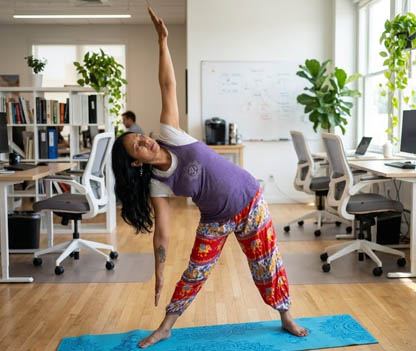
Fully locking the knee joint (hyperextending it) in poses like Triangle or Standing Forward Fold puts strain on the ligaments behind the knee. Keep a micro-bend in the knee, even in "straight leg" poses.
Any Pose Causing Sharp Pain, Clicking with Pain, or a Feeling of Instability
Mild stretching sensation is fine. However, sharp pain, clicking with pain, or a feeling of instability during or after practice are signs to stop and consult a healthcare provider.
A Gentle Sequence for Knee and Joint Health
A supportive routine to try (about 15–20 minutes):
- Ankle Circles and Calf Raises - a few rounds each
- Seated Figure-Four Stretch - both sides
- Supported Bridge Pose - 3–5 breaths, 2–3 rounds
- Standing Quad Stretch (with support) both sides
- Chair Pose (shallow depth) - 3–5 breaths, 2 rounds
- Supported Warrior II - both sides, shallow depth
- Reclined Hand-to-Big-Toe Stretch (with strap) both sides
- Legs-Up-The-Wall - 5–10 minutes
Move slowly and mindfully, prioritizing alignment over depth throughout.
Building Long-Term Joint Health, Beyond the Mat
- Strengthen the muscles around the joint, especially the quadriceps, hamstrings, and glutes - strong supporting muscles reduce direct load on the knee itself.
- Maintain healthy body weight, as this directly reduces the load the knees bear with every step.
- Choose low-impact movement (walking, swimming, cycling, yoga) alongside strength work, especially if you have existing joint sensitivity.
- Warm up before deeper stretches - cold joints and muscles are more prone to strain.
- Listen consistently, not just occasionally - chronic, ignored discomfort tends to compound; addressing small issues early prevents bigger ones later.
The Takeaway
Yoga can be a wonderful ally for knee and joint health - building strength, flexibility, and alignment awareness that keep joints resilient over time. But knees respond best to a thoughtful, alignment-focused approach rather than pushing for depth or flexibility. Move mindfully, listen to body’s signals, and don't hesitate to modify poses or seek guidance from a healthcare provider or experienced teacher, especially if you have an existing knee condition.
This article is for general informational purposes and isn't a substitute for personalized medical advice. If you have persistent knee pain, swelling, instability, or a diagnosed joint condition, please consult a doctor or physical therapist before starting a new yoga practice.