Yoga for Desk Workers
Yoga for Desk Workers: Feel the Ease
If your workday looks like eight (or more) hours parked in a chair, hunched slightly forward, eyes fixed on a screen, your body is quietly paying a price for it. Tight hips, rounded shoulders, a stiff neck, an aching lower back, and that dull, heavy fatigue. They're your body's response to hours of stillness and poor postural habits, compounding day after day.
The good news: you don't need an hour-long yoga class or gym membership to counteract this. A handful of well-chosen poses done consistently, even in short bursts can undo much of the damage of a sedentary day. This guide explains why sitting affects your body the way it does and offers a practical sequence you can do at your desk, on a break, or at home after work.
What Sitting All Day Actually Does to Your Body
Understanding the problem makes more sense:
- Hip flexors shorten. Sitting keeps your hip flexors (the muscles connecting your thighs to your torso) in a constantly shortened position. Over time, they tighten, which can pull on the lower back and contribute to pain.
- Glutes "forget" how to fire. Prolonged sitting weakens and deactivates the glute muscles, which are meant to support your hips and lower back - a phenomenon sometimes called "gluteal amnesia."
- Upper back and shoulders round forward. Reaching for a keyboard or leaning toward a screen encourages rounded shoulders and a forward head position, straining the neck and upper back.
- Spine loses its natural curve. Slouching flattens the lower back's natural curve, shifting pressure onto spinal discs.
- Circulation slows. Long static sitting reduces blood flow to the legs, which can contribute to stiffness, swelling, and fatigue.
None of this happens overnight - but it compounds. The upside is that gentle, targeted movement can start reversing it almost immediately.
Before You Start
- These poses can be done in work clothes - no mat required, though one helps for floor poses.
- Move slowly and breathe steadily; nothing here should cause sharp pain.
- Even 5-10 minutes, broken into two short desk breaks, makes a meaningful difference.
- If you have an existing back, neck, or joint injury, check with a doctor or physical therapist before starting a new routine.
Part 1: At-Your-Desk Poses (No Mat Needed)
1. Seated Cat-Cow
Benefits: Releases Spinal stiffness from prolonged stillness
- Sitting toward the edge of your chair, feet flat on the floor, hands resting on your knees.
- Inhale: Arch your back, lift your chest, and let your shoulder blades draw together (cow).
- Exhale: Round your spine, tuck your chin, and draw your belly button in (cat).
- Continue flowing between the two for 8–10 breaths.
2. Seated Spinal Twist
Benefits: Releases stiffness and tension built up along the spine
- Sit tall, feet flat on the floor.
- Place your right hand on the back of your chair and your left hand on your right knee.
- Inhale to lengthen your spine, exhale to gently twist to the right.
- Hold for 4-5 breaths, then switch sides.
3. Seated Figure-Four Stretch
Benefits: Ease tight hips and glutes from sitting
- Sit tall. Cross your right ankle over your left knee, flexing the right foot to protect the knee.
- Gently hinge forward from the hips until you feel a stretch in the right hip/glute.
- Hold for 5-8 breaths, then switch sides.
4. Wrist and Forearm Stretch
Benefits: Releases tension from typing and mouse use
- Extend one arm forward, palm facing up.
- With your other hand, gently pull the fingers back toward you until you feel a stretch in the forearm.
- Hold for 5 breaths, then flip the palm face down and repeat, pulling fingers gently toward the floor.
- Switch sides.
5. Neck Release
Benefits: Releases the tension from forward head posture
- Sit tall, drop your right ear toward your right shoulder (don't lift the shoulder to meet it).
- For a deeper stretch, gently rest your right hand on the top of your head, no pulling, just light weight.
- Hold for 5 breaths, then switch sides.
- Finish with slow, gentle neck rolls in each direction.
Part 2: Standing Poses (Ideal for a Quick Break)
6. Standing Forward Fold
Benefits: Helps in Spinal compression, tight hamstrings, and mental fog
- Stand up, feet hip-width apart.
- Slowly hinge forward from the hips, letting your head and arms hang heavy. Bend your knees generously if your hamstrings are tight.
- Sway gently side to side, or hold still, breathing deeply for 5–8 breaths.
- Roll up slowly, one vertebra at a time.
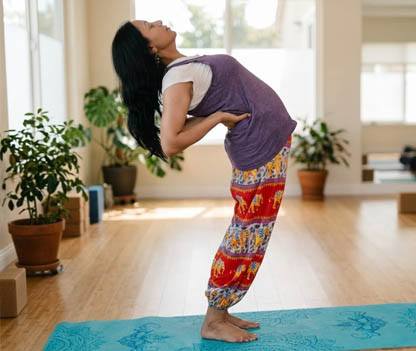
7. Standing Backbend
Benefits: Release stiffness from hours of forward-hunched posture
- Stand with feet hip-width apart, hands supporting your lower back.
- Gently lean back, lifting your chest toward the ceiling, keeping the movement small and controlled.
- Hold for 3–5 breaths.
8. Chest Opener (Doorway Stretch or Interlaced Hands)
Benefits: Release stiffness from rounded shoulders
- Stand tall, interlace your hands behind your back, and gently straighten your arms.
- Lift your chest slightly and draw your shoulder blades toward each other.
- Hold for 5–8 breaths.
- Alternative: Stand in a doorway, place forearms on the frame, and gently lean forward to open the chest.
9. Standing Hip Flexor Stretch (Low Lunge Variation)
Benefits: Fix tight hips, and ease low back pain from sitting
- Take a large step back with your right foot into a gentle lunge (using a chair or wall for balance if needed).
- Keep your torso upright and gently press your right hip forward until you feel a stretch at the front of the right hip.
- Hold for 5 breaths, then switch sides.
Part 3: A Few Floor Poses (For After Work or a Longer Break)
10. Cat-Cow on All Fours
Undoes: Deep spinal stiffness (a deeper version of the seated variation)
- Come to hands and knees, wrists under shoulders, knees under hips.
- Inhale, drop the belly, lift the chest and tailbone (cow).
- Exhale, round the spine, tuck the chin and tailbone (cat).
- Flow for 8–10 breaths.
11. Child's Pose
Undoes: Lower back tension, offers a full body reset
- From hands and knees, sit your hips back toward your heels, extending your arms forward (or resting them alongside your body).
- Let your forehead rest on the mat or floor.
- Breathe deeply for 30–60 seconds.
12. Legs-Up-The-Wall
Undoes: Poor circulation from prolonged sitting, calms the nervous system
- Sit sideways next to a wall, then swing your legs up the wall as you lie back.
- Let your arms rest by your sides, palms up.
- Stay for 3–5 minutes, breathing slowly. This is especially good at the end of a long day.
A Simple 10-Minute Desk-Break Routine
If you only have a few minutes, here's a sequence that hits the major problem areas:
- Seated Cat-Cow - 8 breaths
- Seated Spinal Twist - both sides
- Seated Figure-Four - both sides
- Standing Forward Fold - 5 breaths
- Standing Backbend - 3 breaths
- Chest Opener - 5 breaths
Set a reminder to do this once mid-morning and once mid-afternoon, and you'll likely notice less stiffness and more energy by the end of the day.
Small Habits That Add Up
Beyond the poses themselves, a few habit shifts can meaningfully reduce the toll of desk work:
- Set a movement reminder every 45-60 minutes - even standing up and taking a few steps helps.
- Adjust your workstation so your screen is at eye level, and your feet rest flat on the floor.
- Alternate sitting and standing, if you have access to a standing desk.
- Take walking meetings or phone calls when possible.
The Takeaway
Your body wasn't designed to stay still for eight hours a day - but a sedentary job doesn't have to mean a stiff, achy body. A few minutes of intentional movement, woven into your workday, can undo much of the tension that builds up from sitting. Start small, stay consistent, and let your body remind you how good it feels to move.
If you experience persistent or worsening pain, please consult a doctor or physical therapist rather than relying on stretching alone.