Yoga for Back Pain
Yoga for Back Pain: Safe Poses and What to Avoid
The spine is complex and every "back pain" isn't the same: a disc issue, muscular tension, sciatica, and postural strain each respond differently to movement. A pose that soothes one person's back might aggravate another's.
This guide walks through how to approach yoga safely when dealing with back pain, which poses tend to help, which movements to be cautious with, and how to build a gentle, supportive practice without turning your mat into another source of strain.
First, a Few Important Notes
Before diving into poses, some honest ground rules:
- This is general guidance, not a diagnosis or treatment plan. Back pain has many causes (muscular, disc-related, nerve-related, postural, structural), and what helps one type can worsen another.
- If you have a diagnosed condition - a herniated or bulging disc, sciatica, spinal stenosis, osteoporosis, or a recent injury - please consult a doctor or physical therapist before starting any new movement practice and ideally work with a yoga therapist.
- Sharp, shooting, or radiating pain is a stop signal. Mild stretching sensation is normal. Sharp pain, numbness, or tingling down the legs is not normal. Stop immediately if you feel this.
Why Yoga Can Help Back Pain
Most non-structural back pain (the kind not caused by a specific injury or diagnosed spinal condition) is linked to a combination of:
- Muscular imbalance - tight hip flexors and hamstrings pulling on the pelvis, weak core and glute muscles failing to support the spine
- Poor postural habits - prolonged sitting, forward head posture, slouching
- Nervous system tension - chronic stress can increase muscular guarding and tension around the spine
- Reduced mobility - stiffness that limits the spine's natural range of motion, leading to compensation patterns elsewhere
Yoga addresses several of these at once: it gently builds core and postural strength, releases chronically tight muscles (like hip flexors and hamstrings), improves spinal mobility, and calms the nervous system - reducing the muscular guarding that often accompanies pain.
Safe Poses for Back Pain
You don't need much room for this, and most practices can be done without leaving your seat and won't disturb your neighbor.
1. Cat-Cow (Marjaryasana-Bitilasana)
Why it helps: Gently mobilizes the entire spine through flexion and extension, without holding any position long enough to strain.
- Come to hands and knees, wrists under shoulders, knees under hips.
- Inhale, drop the belly, lift the chest and tailbone (cow).
- Exhale, round the spine, tuck the chin and tailbone (cat).
- Move slowly, syncing with the breath, for 8–10 rounds.
2. Child's Pose (Balasana)
Why it helps: A gentle, supported stretch for the lower back with no weight-bearing compression.
- From hands and knees, sit hips back toward heels, arms extended forward or resting alongside the body.
- Rest your forehead down. If your hips don't reach your heels comfortably, place a cushion between them.
- Hold for 30–60 seconds, breathing deeply.
3. Supine Knee-to-Chest (Apanasana)
Why it helps: Gently releases lower back tension by decompressing the lumbar spine.
- Lie on your back, hug one or both knees toward your chest.
- Hold for 5-8 breaths. If bringing both knees in, keep the movement gentle - don't pull forcefully.
4. Reclined Spinal Twist (Supta Matsyendrasana)
Why it helps: Releases tension along the spine and outer hips without any weight-bearing load.
- Lying on your back, hug both knees to the chest, then let them fall gently to one side while keeping both shoulders grounded.
- Hold 5-8 breaths, then switch sides. Keep the twist gentle - you should feel a release, not a strain.
5. Bridge Pose (Setu Bandhasana)
Why it helps: Strengthens the glutes and hamstrings, which support the lower back, while gently opening the front of the hips.
- Lie on your back, knees bent, feet hip-width apart, flat on the floor near your hips.
- Press through your feet to lift your hips, keeping the lift comfortable (you don't need to go high).
- Hold for a few breaths, or gently pulse up and down, then lower slowly.
6. Sphinx Pose
Why it helps: A gentle backbend that strengthens the muscles supporting the lower spine without the intensity of a deeper backbend.
- Lie on your belly, forearms on the floor, elbows under shoulders.
- Gently lift your chest, keeping the lower back relaxed rather than gripping.
- Hold for 5–10 breaths. Keep this gentle - you should feel support, not compression.
7. Legs-Up-The-Wall (Viparita Karani)
Why it helps: Fully decompresses the spine and calms the nervous system, reducing the muscular guarding that often accompanies chronic pain.
- Lie on your back with legs extended up a wall, arms relaxed by your sides.
- Stay for 5–10 minutes, breathing slowly.
8. Standing Forward Fold (Modified, Knees Bent)
Why it helps: Gently stretches the hamstrings and lower back - bending the knees generously protects the spine from overstretching.
- Feet hip-width apart, knees softly bent throughout.
- Hinge forward from the hips, letting your head and arms hang.
- Hold for 5–8 breaths, then roll up slowly, one vertebra at a time.
9. Gentle Core Work: Dead Bug or Pelvic Tilts
Why it helps: Builds core stability, which supports and protects the lower back over time.
- Pelvic tilts: Lying on your back, knees bent, gently flatten your lower back into the floor by engaging your lower abdominals, then release. Repeat 10–12 times.
- Dead bug (if pain-free): Lying on your back, arms reaching up and knees bent at 90 degrees, slowly lower one arm and the opposite leg toward the floor, keeping the lower back pressed gently into the mat. Alternate sides.
Poses and Movements to Approach with Caution (or avoid)
Not every yoga pose is back-friendly - especially for people with existing pain or spinal conditions. A few to be cautious with:
Deep Forward Folds (especially with straight, locked knees)
Rounding the spine deeply while standing, particularly with straight legs, places significant pressure on spinal discs. If you fold forward, keep knees soft and prioritize a flat back over touching your toes.
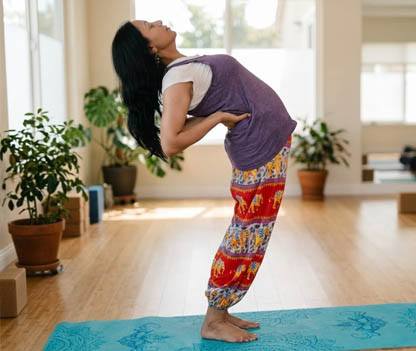
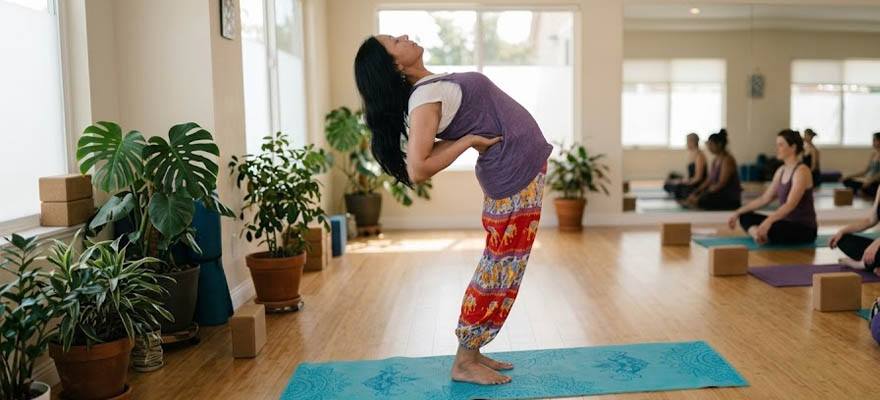
Deep Backbends (Full Wheel, Camel, Deep Cobra)
These poses require significant spinal extension and core strength. Without adequate preparation and strength, they can strain the lower back - especially for those with disc issues. Beginners with back pain should stick to gentle backbends like Sphinx or a small Cobra, rather than deeper variations.
Unsupported Twists with Excessive Force
Gentle twists are generally fine, but forcing a deep twist - especially seated twists where you crank the torso using your arms for leverage - can strain the lower back and discs. Twist from the breath, not from pulling with your arms.
Full Sit-Ups or Rapid Crunches
Repeated spinal flexion under load (like traditional sit-ups) can aggravate disc-related back pain. Gentler core work (like pelvic tilts or dead bug) builds the same stability with far less spinal stress.
Headstand, Shoulder stand, and Other Inversions (for beginners or those with acute pain)
These poses place significant load on the neck and spine and require both strength and proper alignment. They're generally not appropriate for beginners with back pain, and should only be attempted, if at all, under experienced guidance once pain has been resolved.
Locust Pose and Superman Variations (in the acute phase)
These require lifting both the upper body and legs simultaneously, creating a strong compressive force on the lower back. They can be valuable for building back strength - but usually later in a recovery process, not during acute pain.
Any Pose That Causes Sharp Pain, Numbness, or Tingling
This is the most important rule of all. Sensation traveling down the leg, numbness, or sharp localized pain are signs to stop immediately and consult a healthcare provider - these can indicate nerve involvement that yoga alone shouldn't be used to "push through."
A Gentle Sequence for Back Pain Relief
A safe starting sequence to try (about 15–20 minutes):
- Cat-Cow - 8–10 rounds
- Child's Pose - 60 seconds
- Supine Knee-to-Chest - 5–8 breaths each side (or both knees together)
- Reclined Spinal Twist - 5–8 breaths each side
- Pelvic Tilts - 10–12 reps
- Bridge Pose - 5 breaths, 2–3 rounds
- Sphinx Pose - 5–10 breaths
- Legs-Up-The-Wall - 5–10 minutes
Move slowly, breathe steadily throughout, and skip anything that increases pain rather than easing it.
Building Long-Term Back Health, Beyond the Mat
Yoga is most effective as part of a broader approach to back health:
- Move regularly throughout the day - prolonged sitting is one of the biggest contributors to back pain; short movement breaks matter as much as your yoga practice.
- Strengthen the core and glutes gradually over time - these muscles are your spine's main support system.
- Mind your posture, especially at a desk - screen height, chair support, and how you sit all matter.
- Manage stress - chronic stress increases muscular tension, which often shows up in the back.
- Be patient - back pain often improves gradually with consistent, gentle movement rather than intense or sporadic effort.
The Takeaway
Yoga can be a genuinely powerful tool for easing back pain - but the approach matters as much as the poses themselves. Gentle, consistent movement that respects your body's signals will do far more good than pushing into deep stretches or advanced poses before you're ready. When in doubt, go gentler, go slower, and don't hesitate to work with a healthcare provider or experienced teacher, especially if pain persists or worsens.
This article is for general informational purposes and isn't a substitute for personalized medical advice. If you have chronic, severe, or worsening back pain - or any numbness, tingling, or weakness in your legs - please consult a doctor or physical therapist before starting a new yoga practice.