Yoga for Travellers
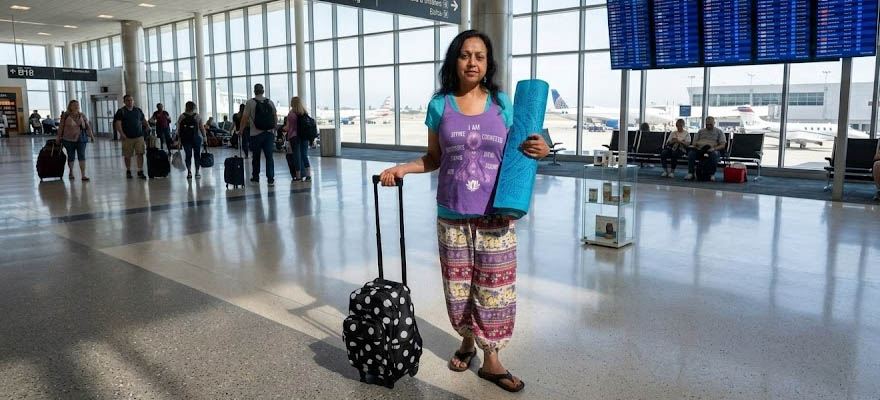
Yoga for Travel: Quick routines for Jet Lag and Cramped Spaces
Travel exhaustion with wide-eyed tiredness, the stiff-necked, and foggy head are not comfortable for most of us. Cramped airplane seats, long layovers, disrupted sleep, and time zones that scramble your internal clock all take a toll on the body and mind.
The good news is that yoga doesn't need space, equipment, or even much time to be effective. Many of the most useful poses and breathing techniques for travel can be done in an airplane seat, a hotel room, or a corner of an airport gate. This guide offers simple, practical routines to help you arrive feeling less depleted and recover faster once you land.
Why travel is so bard on the body
Understanding what's happening helps explain why these practices work:
- Prolonged sitting in a cramped seat restricts circulation, tightens hips and hamstrings, and compresses the spine.
- Cabin air is dry, which can leave you dehydrated, foggy, and fatigued.
- Time zone shifts disrupt your circadian rhythm - the internal clock that regulates sleep, digestion, and energy - leading to classic jet lag symptoms: fatigue, disorientation, and disrupted sleep.
- Stress and disrupted routine (rushing through security, unfamiliar surroundings, irregular meals) keep the nervous system in a low-grade "on alert" state.
Yoga addresses all four: it gets circulation moving, calms the nervous system, and when timed well, can even help reset your body clock faster.
Part 1: In-Seat Yoga (for the Plane, Train, or Car)
You don't need much room for this, and most practices can be done without leaving your seat and won't disturb your neighbor.
1. Seated Ankle Circles and Toe Pumps
Helps with: Circulation, swelling, blood clot risk on long flights
- Lift one foot slightly, circle the ankle 8–10 times in each direction.
- Then flex and point the foot repeatedly (toe pumps) for 10–15 reps.
- Repeat with the other foot. Do this every hour or so on long flights.
2. Seated Cat-Cow
Helps with: Spinal stiffness from sitting still
- Hands on knees, spine tall.
- Inhale, arch the back and lift the chest (cow).
- Exhale, round the spine and tuck the chin (cat).
- Flow slowly for 8–10 breaths.
3. Seated Spinal Twist
Helps with: Releasing tension built up along the back
- Sitting tall, place your right hand on the outside of your left armrest (or your knee), left hand behind you.
- Inhale to lengthen the spine, exhale to twist gently.
- Hold 4–5 breaths, then switch sides.
4. Seated Forward Fold (Modified)
Helps with: Lower back tension, calming the nervous system
- Sitting tall, hinge forward from the hips, letting your torso rest toward your thighs (as far as space allows).
- Let your arms hang or rest on your legs. Breathe here for 5–8 breaths.
- Roll back up slowly.
5. Seated Eagle Arms
Helps with: Tight shoulders and upper back from cramped positioning
- Extend arms forward, cross the right arm over the left, and bend elbows, bringing palms or backs of hands together (or holding opposite shoulders if that's more accessible).
- Lift the elbows slightly, feeling a stretch across the upper back.
- Hold 5 breaths, then switch the cross of the arms.
6. Neck and Shoulder Rolls
Helps with: Tension from sleeping upright or awkward angles
- Slowly drop the right ear to the right shoulder, hold 3–5 breaths, then switch sides.
- Follow with slow shoulder rolls and backward a few times, then forward.
7. Wrist and Finger Stretches
Helps with: Stiffness from holding a phone, tablet, or book
- Extend one arm, palm up, gently pull fingers back with the other hand. Hold 5 breaths.
- Flip palm down, gently pull fingers toward you. Hold 5 breaths.
- Switch sides.
Guidelines to manage claustrophobic symptoms
1. Belly Breathing (Diaphragmatic Breath):
Slows the heart rate and signals safety to the nervous system. It is best used the moment you feel the first flutter of panic.
Place one hand on chest, one on belly; feel belly rise as you breathe, chest stay still.
Inhale slowly through the nose for a count of 4, letting belly expand.
Hold gently for a count of 2.
Exhale slowly through the nose for a count of 6 or 8, letting belly gently shrink towards spine.
Pair each affirmation with one slow exhale,
'I am safe' (exhale)
'My body is calm; my mind is clear'
I am enough just as I am.
I love and accept myself.
I forgive myself and let go.
I am free from the past and embrace the present.
I am doing my best, and that is enough.
I release fear and welcome peace.
Wherever I go, I am well.
I can handle whatever comes my way.
I am safe and protected.
I trust the journey of my life.
2. Progressive Muscle Release
Claustrophobia often shows up as physical tension first - releasing it directly can break the panic cycle.
Starting at feet, tense muscles hard for 5 seconds, then release completely.
Move upward: calves, thighs, hands, shoulders, jaw.
3. Mindful Grounding (5-4-3-2-1)
Pulls attention out of 'trapped' thoughts and back into the immediate, safe physical space around you.
Name 5 things you can see (seatbelt sign, window shade, pattern on seat, etc.)
Name 4 things you can physically feel (armrest, fabric of clothes, feet on floor)
Name 3 things you can hear (engine hum, voices, air vent).
A few practical tips: -
It helps to practice belly breathing and the affirmations a few times before the flight (even just at home) so they feel familiar rather than new when anxiety hits.
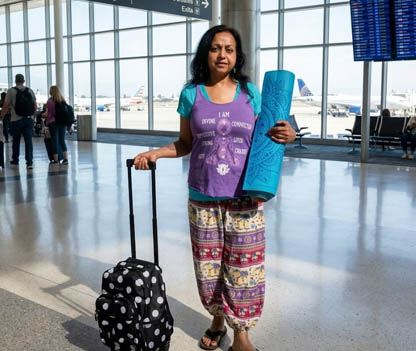
Part 2: Airport Gate or Layover Routine (Standing, More Room)
If you have a few extra minutes and a bit more space - a quiet corner near your gate works well.
8. Standing Forward Fold
- Feet hip-width apart, hinge forward from the hips, letting your head hang heavy.
- Bend knees generously if needed. Hold 5–8 breaths, then roll up slowly.
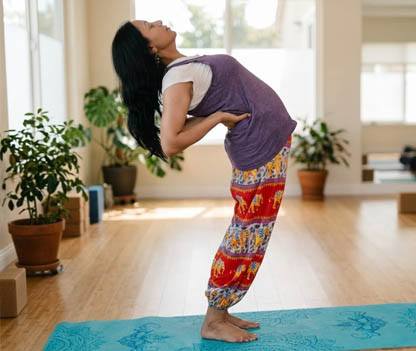
9. Standing Backbend
- Hands supporting your lower back, gently lean back and lift the chest.
- Hold 3–5 breaths - a small, controlled movement is enough.
10. Standing Hip Flexor Stretch
- Step one foot back into a gentle lunge.
- Keep the torso upright, gently press the back hip forward.
- Hold 5 breaths, switch sides.
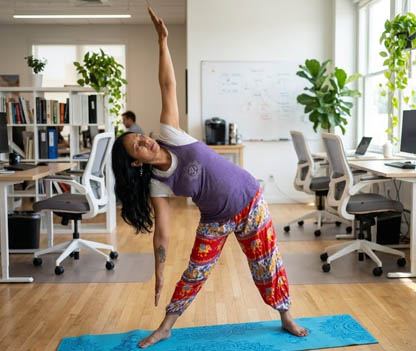
11. Standing Side Stretch
- Reach both arms overhead, clasp hands (or interlace fingers, index fingers pointed up), and lean gently to one side.
- Hold 4–5 breaths, then switch sides.
Part 3: Hotel Room Reset (After You Land)
Once you've arrived, a short floor sequence can help release travel tension and start syncing your body to the new time zone.
12. Child's Pose
- Sit hips back toward heels, arms extended forward or by your sides, forehead resting down.
- Breathe deeply for 30-60 seconds. A full body reset.
13. Legs-Up-The-Wall
- Lie on your back with legs extended up a wall, arms relaxed by your sides.
- Stay for 5–10 minutes. This is excellent for calming the nervous system, easing swollen feet/ankles from flying, and encouraging restful sleep.
14. Reclined Spinal Twist
- Lying on your back, hug knees to chest, then let both knees fall to one side while keeping shoulders grounded.
- Hold 5-8 breaths, then switch sides.
15. Gentle Supine Breathing (Belly Breathing)
- Lying down, one hand on chest, one on belly.
- Breathe slowly, feeling the belly rise and fall, for 2-3 minutes.
- Especially helpful before sleeping in a new time zone.
Breathwork for Jet Lag
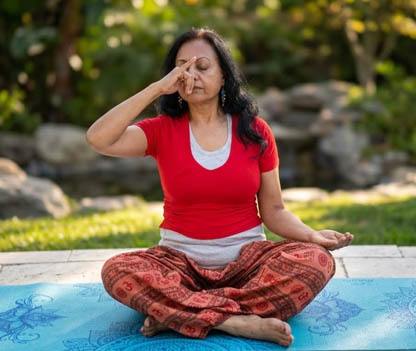
Beyond poses, breath is one of your fastest tools for shifting your state - useful for both staying calm mid-travel and adjusting your body clock.
- To feel more alert (daytime arrival): Try a few rounds of Kapalabhati (skull-shining breath) - short, forceful exhales through the nose, with passive inhales. (Skip this if you are pregnant or if you have high blood pressure, heart, or respiratory conditions.)
- To wind down (nighttime arrival or before sleep): Practice a longer exhale than inhale - inhale for 4 counts, exhale for 6-8 counts - to activate the body's rest response.
- For general calm during travel stress: Box breathing (inhale 4, hold 4, exhale 4, hold 4) is discreet enough to do anywhere, including mid-flight or in a security line.
A Simple Jet-Lag Recovery Routine
Combine movement, light exposure, and timing for the fastest reset:
- On the plane: every hour, do a round of ankle circles, seated cat-cow, and a spinal twist.
- On arrival: get natural sunlight as soon as possible - it's one of the strongest cues for resetting your circadian rhythm.
- That evening: Do the Hotel Room Reset sequence (Child's Pose, Legs-Up-The-Wall, Reclined Twist, Belly Breathing) before bed, even if it's not your "usual" bedtime yet.
- Next few days: Repeat the evening sequence nightly to reinforce the new sleep schedule and use box breathing during the day if fatigue or brain fog hits.
A Few Extra Travel Tips
- Hydrate generously - cabin air is dehydrating, which worsens both stiffness and jet lag.
- Move every hour on long flights, even if it's just standing and shifting weight foot to foot.
- Avoid excess caffeine and alcohol in the 24 hours around your flight which disrupt sleep quality, which is already fragile during travel.
- Try to align meals and light exposure to your destination's time zone as soon as you board, if possible.
The Takeaway
Travel doesn't have to leave you depleted. A few minutes of mindful movement - in your seat, at the gate, or in your hotel room - can ease the physical strain of cramped spaces and help your body recalibrate faster to a new time zone. You don't need a mat, a studio, or even a lot of space. Just a few conscious breaths and a willingness to move, wherever you happen to be.
If you have circulation issues, a history of blood clots, or other health conditions, consult your doctor before long flights, and consider additional precautions like compression socks and regular movement breaks.